
Managing Hypothermia
I Think I May Have Saved a Dog’s Life …
One Cold, Wet and Windy Day in the Peak District …
Kinder Scout in the Peak District with some clients. The weather was horrendous: rain, clag and high winds. We were just beyond the top of Crowden Clough when two young ladies came out of the murk, sobbing that their dog was having a seizure and they didn’t know what to do: could I help? Her dog was slumped lifeless in her arms, not looking well at all.
Get the casualties out of the environment
It was cold, and the first thing I noticed was that this one lass had taken her own coat off and wrapped it around her dog, and she was just wearing a base-layer for herself. On such days, I always carry a group-shelter, which is like a small parachute. I deployed this and then suddenly all the noise and all of the wind were gone. Relative silence. We hunched in a circle with the shelter stretched around our backs and the wind was no longer ripping through us and, no longer robbing us of our heat.
I wanted to know if the casualty was still alive. He was just about able to open his eyes, and his gums looked pink (which told me there was still oxygenated blood being pumped to the surface, and so his heart must be working). I think the key reason I wanted to do this is because I wanted something positive to tell the poor girl holding her limp dog.
The patient here was an Italian greyhound called Marv. He was dressed in his own warm coat (and his owner’s one now), but the day’s exertions had just been too much.
Don’t rub a cold casualty
The young lady started rubbing Marv to get him warm – and I needed to stop her doing this. When we rub our skin, the capillaries dilate and open up and bring more blood to the surface, which then cools and returns to the core.
Treat the whole team for hypothermia
I knew the casualty here needed sugar. If he were going to create any heat he would need to metabolise energy. He wasn’t able to eat for himself, but I did have some glucose gel in my first aid kit and so I rubbed this into his gums. Marv had a sibling, though looking in a much safer state, was also being carried by the other lass. If there’s one casualty with hypothermia, you have always got to ask yourself, who’s next!? So I gave him some of the gel too, which he happily licked off my fingers.
Marv’s owner was my next concern. This whole time she had been kneeling there in her wet skin-tight top, still with her coat wrapped around Marv. We agreed a plan: I’d give my spare layer to Marv, and she would put her own coat back on. Then we’d put Marv down her front, and with a climbing sling I had, we’d tie him in securely.
Not dead until they’re warm and dead
Marv was now looking really bad. He was still limp in her arms but not responding in any way: he was no longer opening his eyes. The poor owner was sobbing that her dog was dead. The words “not dead until he’s warm and dead” came to mind, but I chose not to say them. I did try to reassure her, however, that really cold casualties do a really good job of looking really ill, and that actually I thought Marv might be alright once he’d properly warmed up again, in a few hours time. A cold casualty can’t be pronounced dead: they have to be slowly warmed up to normal body temperature before a diagnosis of death can be pronounced.
Hastily we stashed the group shelter away and carefully made our way down to my car. I drove the two girls and the dogs back to their waiting car, and they drove to the vets. A few hours later Marv was, as predicted right as rain, sat up right ready for his next adventure on the floor of the vets.
Post Note: the owner of Marv felt beside herself with guilt that this had happened. But she was not to blame. Every weekend she would take her dogs out in all weathers, and to date they had always been fine. They were a pair of well-exercised dogs, happy and well wrapped up for these conditions.

What is hypothermia?
Hypothermia means low (hypo rhymes with low), temperature of the core. Normally our core temperature is about 37C. We’re defined as being hypothermic if our temperature is 35C or less.
What does hypothermia look like?
When our brains don’t get the right levels of oxygen, sugar or in this case, the right temperature of blood, our ability to process information and act normally is affected.
The casualty may initially look withdrawn, miserable and despondent. Slowly as things get worse, they may not speak clearly, they can lose their fine motor skills (can’t do zips/buttons) and eventually not be able to walk or stand up. When we’re shivering we’re at least able to warm ourselves up, but if we are no longer shivering, we are in a very critical condition. (Our core temperature will now be below about 32 degrees C).
What can we do for the casualty with hypothermia?
In essence we need to go back to the principles of first aid and the basics of physics … We want to prevent worsening and then promote recovery. To do this we need to stop the process of convection and evaporation. Typically the casualty is cold and the wind is further cooling that cold casualty. By putting a barrier (group shelter, survival bag, extra coat …) in place the process of evaporation ceases.
Additionally, the deployment of a group shelter for example, means the ambient air is able then to warm up, and the air that the casualty is breathing is warmer also. This helps prevent heat loss by respiration.
Wet clothes on the skin will be taking heat from the casualty by conduction. If we’re more than 30 minutes from a vehicle or proper hard-standing warm shelter, and we are able to safely swap wet clothes for dry clothes then we should do so. Wet clothes take heat from the casualty’s body to dry themselves out.
To promote recovery and to get warmer the casualty needs energy. Consuming high calorie food and fluids is key here. A cold can of full sugar Coke is better than an unsweetened mug of hot coffee. (Though the hot drink will always have a hugely rewarding psychological effect). Ideally, once they have their layers sorted, and they have consumed some calories we need to get them walking again, which will further help them to warm up.
What if their levels of consciousness are dropping?
When a casualty stops shivering this marks a sign that things are quite seriously getting worse: they are no longer able to warm themselves up. As they get colder, (and their blood gets cooler), it is harder for the oxygen in the blood to transfer to the muscles of the heart and the heart becomes at increased odds of going into cardiac arrest.
It’s near on impossible to get an accurate reading of a casualty’s core temperature in the wilderness or mountain environment. (Tympanic thermometers are not very reliable for measuring temperatures accurately below 34C). To that end we have to rely on the casualty’s levels of consciousness to help us to make decisions. Using an aid called the Revised Swiss Staging System we know that a casualty who can only respond to verbal commands is at moderate risk of going into cardiac arrest from hypothermia and so on. (See the table below).
Note, when checking a cold casualty’s respiratory rate, you should do so for 1 minute at a time. You may count just two breaths per minute (or maybe none).
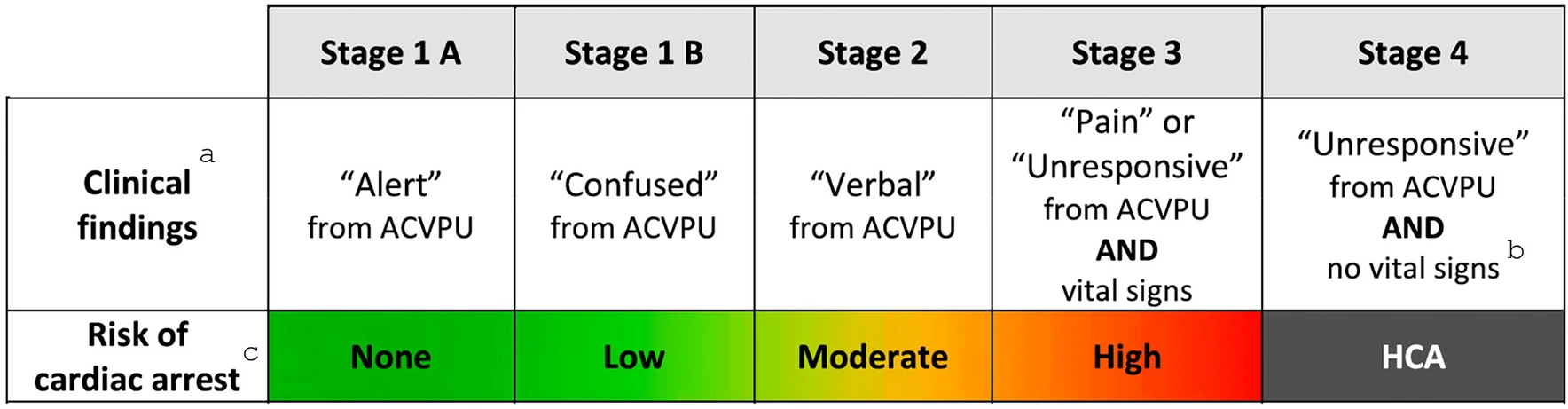
As a first-aider there is not much more we can do at this stage for our casualty… We must be extremely careful with our casualty: no sudden or violent movements. (Treat as a spinal-casualty). As a first-aider we will not commence CPR on a cold casualty in the wilderness context (even if breathing is absent or not normal: since we’re unlikely to be able to maintain this). If the casualty is not in cardiac arrest, CPR may actually have the effect of putting them into a cardiac arrest.
What we will do, is wrap the casualty up as best we can, insulate them from the floor and we will need to call out the emergency services. Any chemical heat pads placed in the groin between the legs, or in chest pockets may help to prevent any further worsening.
And finally remember, ask yourself, if there is one casualty with hypothermia, who’s next? Make sure all your team sort their layers while they can, and take this opportunity to eat and drink. Treat everybody for hypothermia.
Key points
- Prevention is always best: hypothermia is entirely preventable. Prepare for hypothermia – don’t wear cotton clothes, take spare layers, eat lots of calories as you go.
- Prepare for the worst and pack a group shelter, a survival bag, and half a roll mat.
- Prevent worsening – get your casualty out of the elements. If you are able to do so, swap wet clothes for dry clothes: this will help. Extra layers will definitely help.
- Promote recovery – if they can safely swallow, give them sugary food and sweet drinks (hot or cold) to consume. If they can’t swallow, rub sugary energy gels into their gums.
- If they can walk themselves off the hill – get them to do so and make your way to a warmer place as safely as possible. Monitor how they are doing all the way.
- Do not rub a cold casualty – this will be counter-productive. Don’t place a heat-pack or a hot water bottle on a shivering casualty either. (On a casualty who is not yet shivering though, this will help prevent hypothermia. Likewise, a casualty with very low levels of consciousness, who is no longer shivering, will benefit from a heat pack placed in their groin or arm pits).
- A cold hypothermic casualty with reduced levels of consciousness needs a 999 emergency call out to the police to coordinate an evacuation by mountain rescue.
- “They’re not dead until they’re warm and dead”! Don’t despair, a cold casualty can look very ill, and still make a good recovery. (So don’t start CPR).
Learn more about Hypothermia . . .
Listen to:
The Resus Room Podcast – Hypothermia
Wilderness Medicine Podcast – Walking Cold Patients
Read:
Hypothermia – a Review – Mountaineering Scotland, February 2022
A regional modification to the Revised Swiss System for clinical staging of hypothermia including confusion
Real First Aid – Overcoming Hypothermia
“Man Found Dead” – Keswick MRT Account
Woman gets hypothermia waiting for ambulance
Watch:
Texting 999
If you’re reading this now, then do these two steps now (literally could be a life-saver)
i. Download the What3Words app to your phone. This app will quickly give you your grid reference even without any signal.
ii. Register your mobile phone with the emergency services before an emergency happens. (Important: You will need to register again if you change your mobile phone number).
If an emergency happens you should only use SMS text message to contact the emergency services if you have no other option. This is because it will take longer than other methods such as calling 999. (You must register with the service beforehand).
Create an SMS message containing the details below:
My name is: | Caller’s full name |
Exact location | What3Words |
Type of incident | What has happened |
Hazards in the area | Trees, pylons, water, terrain traps etc |
Access | Any recommended access routes? |
Number of casualties | How many casualties are there and what’s their condition? |
Emergency services | Which and how many emergency services assets do you think are required? |
Do not assume that your message has been received until you get a message back from the emergency service, an SMS ‘Delivery Report’ does not mean your message has been received.
It can take around 2 minutes for you to get a reply to your emergency message. If you have not received a reply within 3 minutes then send another message straight away. Download and print off your own ETHANE and ATMIST report templates here.
First Aid Articles
Will Legon (author of this article and many other First Aid Articles on this website) works professionally in the outdoors leading groups walking and instructing single pitch rock climbing. Since 2009 Will has been delivering first aid training specialising in Outdoor First Aid Courses. He is an ITC (Immediate Temporary Care) trainer, offering a range of courses accredited by Ofqual and the SQA. In a former life, Will was a maths teacher and an infantry officer in the Territorial Army.
Will4Adventure First Aid is a leading provider of Outdoor First Aid Training offering specialist led First Aid Courses for the outdoors and the workplace.
ALL of our First Aid Courses are regulated by Qualifications Scotland or Ofqual and are Accredited by ITC First.
Our courses all meet HSE Standards for due diligence for First Aid providers.
We regularly receive genuine five star reviews from our trainees.
Our First Aid Courses are taught nationwide in the UK at Training Centres in the North of England, the South of England, and Wales, within easy reach of major cities and popular areas. Book your first aid course with us →